 MD Info
What a slot lobby looks like offshore
Open the lobby of any non gamstop casinos front page and you will land on a slot grid. The visual layout is standardised across the market: rows for "Popular", "New Releases", "Bonus Buy" and provider-branded corners for Pragmatic Play, Nolimit City and NetEnt. Total title counts are typically advertised at 3,000 to 8,000, but the honest working library — titles you will actually recognise from a UK site — is usually 800 to 1,500. The rest is filler from third-tier providers stitched in through aggregator platforms. For a broader survey of the operator market and how it compares to UKGC-licensed rooms, see our non gamstop casinos overview.
The reviewer test on any lobby is straightforward: filter by provider, check that the tier-one names (Pragmatic Play, NetEnt, Play'n GO, Nolimit City, Hacksaw Gaming, Push Gaming, Big Time Gaming) all show meaningful title counts, open two or three titles from each, and confirm the info screen exposes RTP and volatility. If any of those checks fail — no filter option, missing tier-one studios, opaque info screens — the lobby is failing basic transparency and the game selection cannot be trusted.
Tier-one studios: Pragmatic, NetEnt, Play'n GO
Pragmatic Play is the largest volume studio in the segment. Weekly release cadence, hundreds of live titles, and its own live-dealer wing that we cover on a separate page. The signature titles — Sweet Bonanza, Gates of Olympus, Sugar Rush, The Dog House Megaways — are all in the 96%–96.5% RTP band on their standard builds. Watch for Enhanced RTP editions that ship at 96.5% and downgraded editions that drop to 94% or lower. The number lives on the info screen, and the reviewer note is: only stake once you have confirmed it.
NetEnt provides the older marquee brands — Starburst, Gonzo's Quest, Blood Suckers, Dead or Alive II — plus a steadier stream of newer Cluster Pays and grid titles under the Red Tiger sibling brand. Play'n GO ships polished lineage titles including Book of Dead, Rise of Olympus, Reactoonz and the Cluster grid family. Both studios historically shipped a single certified RTP; both now allow operator-configurable RTP on selected releases. The lesson repeats itself: the info screen is the source of truth, not the studio banner.
| Studio | Titles integrated (typical) | Signature title | Common RTP |
|---|---|---|---|
| Pragmatic Play | 200–300 | Sweet Bonanza | 96.5% (standard build) |
| NetEnt | 100–180 | Starburst | 96.1% |
| Play'n GO | 150–220 | Book of Dead | 96.21% |
| Nolimit City | 40–60 | Fire in the Hole | 96.06% |
| Hacksaw Gaming | 50–90 | Wanted Dead or a Wild | 96.38% |
| Push Gaming | 40–80 | Jammin' Jars | 96.83% |
| Big Time Gaming | 25–50 | Bonanza Megaways | 96.00% |
Nolimit City: extreme volatility, xNudge, xBet
Nolimit City is the most reviewer-discussed studio of the current cycle. The xNudge mechanic lets nudged wilds stack multipliers across the bonus round; xBet lets you increase base stake for a higher probability of triggering the bonus. San Quentin xWays broke through as the reference "extreme volatility" title in 2021. Since then Fire in the Hole xBomb, Mental, Tombstone, East Coast vs West Coast and the theme-heavy Serial ranges have set the standard for what "high risk, high reward" means in the sector.
The reviewer position on Nolimit City is honest and mixed. The maths is transparent — RTP 94.20% to 96.20% depending on title and xBet configuration, max win 30,000x to 200,000x, hit-rate on bonus around 0.5% base and 1.4% with xBet enabled. This is not a studio you enter for consistent returns. It is a studio you enter for the possibility of a memorable bonus round on a modest stake, understanding that the median session will end at zero balance. Set your session budget in that light.
Hacksaw Gaming and the modern high-volatility wave
Hacksaw Gaming rose alongside Nolimit City with a slightly softer style. Chaos Crew, Wanted Dead or a Wild, Le Bandit, Cash Compass and the Toshi Video Club series are the reference names. Maximum wins run 15,000x to 100,000x on most builds; RTP typically sits at 96.30% with clean info screens. Where Nolimit leans grim and adult-themed, Hacksaw leans stylised and character-driven. Both share the same structural pattern of long dry base games funding rare bonus peaks.
Other studios in the same wave: Push Gaming (Jammin' Jars, Fat Rabbit, Big Bamboo — 96.5% standard RTP), ELK Studios (some titles ship at extreme volatility with the Betting Strategies feature), and the small independents such as Peter & Sons and No Limit's licensing partners. Coverage across offshore operators varies more here than for tier-one studios — the difference between a well-integrated Hacksaw shelf and a token one can be substantial.
- Nolimit City — extreme volatility, xNudge and xBet mechanics, 30,000x to 200,000x maximum wins.
- Hacksaw Gaming — high volatility, stylised themes, 15,000x to 100,000x maximum wins.
- Push Gaming — high volatility, cluster and Fat mechanics, 5,000x to 30,000x maximum wins.
- ELK Studios — mixed volatility, Betting Strategies feature on select titles.
- Big Time Gaming — inventor of Megaways and Bonanza's Cluster maths.
Megaways licensing and title spread
Megaways is a licensed engine, not a studio. Big Time Gaming invented it (Dragon Born, 2015; Bonanza, 2016) and licenses the ways-based reel mechanic to a growing list of partner studios: Blueprint Gaming (Buffalo Rising Megaways, Diamond Mine Megaways), Pragmatic Play (Big Bass Bonanza Megaways, Sugar Rush Megaways), Red Tiger (Piggy Riches Megaways), iSoftBet, Kalamba and others. At any non gamstop casino you will see dozens of Megaways titles from different studios, and the underlying engine is the same certified maths.
What varies between operators is the RTP variant. Big Time Gaming publishes single-RTP builds (usually 96%), but licensed Megaways titles from Red Tiger and Blueprint have known low-RTP options that lobby-owners can select. Bonanza Megaways is a good reference test: the certified 96% build is standard everywhere, and any lobby shipping it at 94% is telling you something about its wider RTP-integrity approach.
Buy-feature slots and the UK divergence
Bonus-buy — where you pay 50x to 500x the base stake to skip to the feature round — is the clearest content difference between UK-licensed and offshore lobbies. UKGC-licensed sites have been unable to offer bonus-buy since the 2023 White Paper rules on staking and feature-buy tightened. Non gamstop casinos retain it, and it is the single largest content pull for UK players seeking those specific titles offshore. The reviewer view is neutral on the mechanic itself and cautious on the behaviour it encourages: buying a feature at 500x base stake front-loads a session's risk into a single click.
Common bonus-buy pricing: Nolimit City titles range 60x to 200x base stake; Hacksaw runs 50x to 100x; Pragmatic Play sits 80x to 100x for its Ante-Bet variant, plus a dedicated 100x bonus-buy option on Sugar Rush and similar. The buy-round RTP is sometimes slightly higher than the base game (rewarding the fixed investment), but on some titles it is lower — check the info screen row that specifies "RTP when feature is purchased".
RTP variants and the info screen
The single most important habit at a non gamstop casino is opening the info screen before you stake. Look for four values: base RTP, volatility (1-5 stars or descriptive), maximum win multiplier, and the RTP of any bonus-buy or side-bet purchase. A well-configured lobby exposes all four. A poorly-configured one hides one or more. The habit takes ten seconds per title and saves you from the widest single value-drain in the sector — playing a downgraded 94% variant of a title you thought was 96.5%.
- Open the title, press the "i" icon or the game rules link.
- Scroll to the "Return to player" or "Theoretical RTP" row.
- Cross-reference against the studio's own published value (usually a Google search of "Studio Title RTP" returns it).
- Check the maximum win row — often expressed as "x times stake" or a hard cap.
- If any figure is missing or the info screen refuses to load, close the title and try another.
The market is uneven. Some operators default to certified full-RTP variants across their whole shelf; others default to downgraded variants on 40%–60% of their catalogue. In the reviewer sample we walk through as part of every operator review, the split correlates well with wider trust indicators — licensing seriousness, complaints handling, and payout speed.
A specific subtlety worth flagging: buy-feature titles very often carry a lower base-game RTP than their non-buy siblings. The studio maths reasons that the certified average RTP has to reconcile against a much higher feature-hit frequency when the feature can be purchased, and the base game absorbs the shortfall. You will see this on the info screen as two separate rows — one RTP figure for base play, a different (sometimes higher) figure for the purchased feature. If you spin the base game on a buy-feature title without ever buying in, you are frequently playing at 94.0% or 94.5% rather than the 96.2% the title’s non-buy sibling would run. Reviewer takeaway: either commit to the buy-feature economics on those titles, or stake the base game on a version where buy-in is not offered.
A related habit is checking how the info screen labels the RTP row. Some studios write “Theoretical RTP”, others write “Return to player”, and a handful of offshore builds hide the figure behind a “Game rules” link that opens a scrollable PDF. If you cannot find the number in under thirty seconds you are on a title configured for players who do not read it, and that alone is a reason to close the tab. The value the studio publishes on its own website (or via the certification badge on iTech Labs, GLI or eCOGRA) is the reference figure; any operator-side variant below that number is a downgrade, not a bug.
Reviewer footnote: a title's RTP row is not the whole story on offshore rooms. Some studios ship "regional" builds that quietly change base-game hit rates or bonus-trigger frequency without changing the headline RTP number. This is legitimate — the maths still adds up to the certified figure — but it changes the session experience and is one of the reasons a familiar title can feel different at a non-UKGC lobby. The pragmatic response is to treat any given operator's shelf as its own environment and to expect a settle-in period before you can read the volatility rhythm reliably.
Volatility bands and session risk
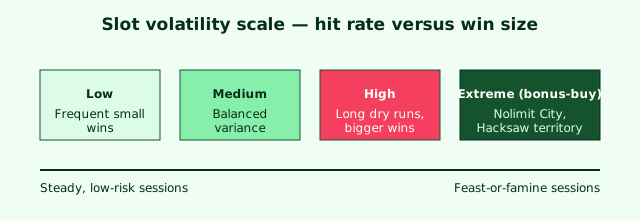
Volatility describes how frequently a title pays and how large those wins tend to be. Low-volatility slots pay frequently with small wins; high-volatility slots pay rarely with large wins; RTP is a long-run average that both bands can share. A 96% low-volatility title and a 96% extreme-volatility title return the same long-run — but the medium-length session experience is entirely different, and the risk of ending on zero within a 200-spin budget is far higher on the extreme-volatility end.
Reviewer heuristic for session budget: assume a "worst realistic" session ends at 30% to 50% of starting balance for low-volatility play, at 0% for extreme-volatility play. Set your session budget as a cash figure you are comfortable losing to zero, not as a spin count you plan to hit. Reality-check yourself every 200 spins or every 45 minutes — offshore lobbies will not do it for you.
Maximum-win multipliers and how to read them
Maximum win is the ceiling on any single spin's payout. Low-volatility slots typically cap at 500x to 2,500x the stake. Medium-volatility slots cap at 5,000x to 15,000x. High-volatility titles reach 20,000x to 30,000x. Extreme-volatility titles from Nolimit City, Hacksaw and Push Gaming reach 50,000x to 200,000x. Any title advertising "unlimited" or "no max win" should be understood as a title with a very small tail probability of the theoretical infinity — practical maxima are bounded by session length and RTP.
Where maximum win matters: it caps the outlier. A £1 spin on a 30,000x cap can theoretically pay £30,000; a £1 spin on a 200,000x cap can theoretically pay £200,000. In practice hit rates on the maximum are one-in-tens-of-millions for the extreme titles. Reviewer position: treat the maximum as a marketing figure, not as an expectation. Session-budget math is unchanged by the cap; you will not hit it.
Frequently Asked Questions
Which slot studios show up at offshore operators?
Pragmatic Play, NetEnt, Play'n GO, Nolimit City, Hacksaw Gaming, Push Gaming and Big Time Gaming for Megaways titles. Yggdrasil, Red Tiger, Thunderkick, ELK, Quickspin, Booongo and Wazdan complete the second row. Coverage varies by operator agreement.
Are the same slots played at UK sites?
Most tier-one titles overlap. A handful are shipped in downgraded RTP variants to offshore skins, a few UK-focused providers do not distribute to non-UKGC operators, and bonus-buy titles are common offshore where they have not been available at UKGC sites since 2023.
What is Megaways and does it work offshore?
Megaways is a licensed reel-engine invented by Big Time Gaming that randomises the symbol count per reel each spin. Blueprint, Pragmatic Play, Red Tiger and other studios build Megaways titles under licence. Offshore operators integrate the same certified maths; RTP variants may differ.
Are buy-feature slots available offshore?
Yes. Bonus-buy titles remain freely available at non gamstop casinos where UKGC-licensed sites have been unable to offer them since the 2023 White Paper rules on feature-buy tightened. Prices range 50x to 500x base stake depending on the title.
How do I check the actual RTP?
Open the game info screen, look for "Return to player" or "Theoretical RTP", and cross-reference against the studio's own published value. The same title can ship at multiple RTP values; the info screen row is the source of truth.
What is the consumer risk to weigh?
Slot mechanics are honest and certified but the wrapper around them is not. No UK dispute recourse if a payout is refused, KYC still triggered at withdrawal, no affordability checks and no reality-check nudges. Set a cash session budget you are comfortable losing.
Responsible Gambling
Non gamstop casinos slot rooms are engineered for retention. Session length is optimised, bonus-buy is aggressive, and the operator will not send you the reality-check pop-ups a UKGC site would. If you are registered with GamStop for problem-gambling reasons, that arrangement remains protective and is not something this page suggests you unwind. If gambling has started to feel compulsive — chasing losses, hiding stakes, playing to escape stress, growing session times — reach out to GamCare on 0808 8020 133, the NHS National Gambling Clinic, GordonMoody residential-support or BeGambleAware. These are named text mentions of independent services, not endorsements; searching for any of them directly will lead you to their sites. For UK regulatory context see the Wikipedia article on the Gambling Act 2005.

Priya Patel
Digital Reviewer · MD Info
Priya reviews casino game libraries and studio partnerships across offshore operators since 2020, focusing on game quality, RTP transparency, and provider integrity. She writes descriptively about market structure, not promotionally about operators.